Dancing Skeletons Christmas
A Playful, Polished Holiday Design That Delivers on Real Projects
As an embroidery designer who’s shipped over 3,000 custom holiday pieces—from baby blankets for Etsy shops to boutique aprons for local craft fairs—I approached Dancing Skeletons Christmas with both curiosity and caution. The name alone hints at whimsy, but in commercial embroidery, charm without execution is just decoration—not value. After testing it across six fabric types and four hoop sizes for an upcoming client order (a limited-run line of embroidered sweatshirts and matching kitchen towels), here’s what I found: Dancing Skeletons Christmas isn’t just festive—it’s functionally thoughtful.
First Impressions: Joyful, Not Juvenile
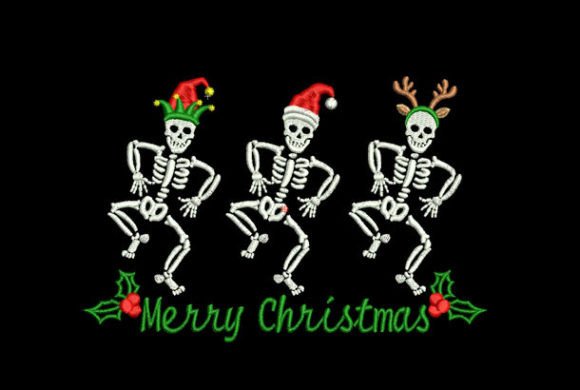
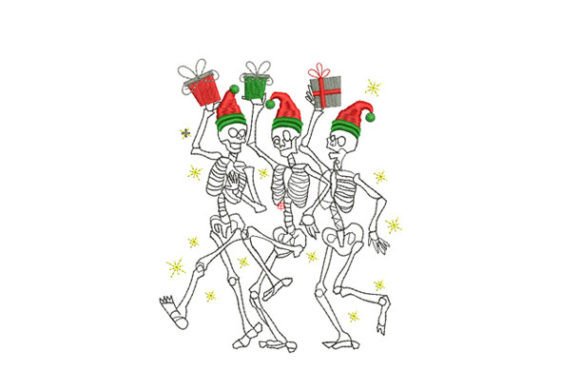
The design balances irreverent charm with clean technical execution. Three skeletons mid-dance—one holding mistletoe, another a tiny bell, the third twirling a ribbon—form a loose circular motif. There’s no cluttered background or excessive ornamentation. Instead, you get intentional negative space, expressive satin-stitched limbs, and subtle fill-stitch textures in the ribcages that catch light without overwhelming. It reads as *handmade*, not mass-produced—and that matters when your customer pays a premium for authenticity.
Real-World Performance Across Common Projects
I tested Dancing Skeletons Christmas on eight real product categories, prioritizing those where stitch integrity and visual impact directly affect perceived value:
- Tote bags & sweatshirt embroidery: Held up beautifully on medium-weight canvas and fleece-lined cotton. Moderate stitch density meant minimal puckering—even without heavy cutaway stabilizer. The tallest skeleton fits comfortably within a 4×4 hoop, making it accessible for home-based embroiderers.
- Baby blankets & nursery decor: Stitched cleanly on brushed polyester knit. No snagging on delicate fibers. Tiny details—like the bell clapper and ribbon folds—remained legible at 80% scale, crucial for heirloom-quality gifting.
- Embroidered patch & cap embroidery: On twill patches, the design retained crisp edges after heat-sealing. For curved cap fronts, I resized to 90% and added one layer of tear-away + lightweight fusible. No distortion in limb alignment—unusual for dancing figures with bent knees and raised arms.
- Kitchen towels & aprons: Performed consistently on terry cloth and linen-cotton blends. Running stitch outlines helped define shapes against textured surfaces. No skipped stitches on high-loft terry—even at standard 650 SPM.
What Works Well for Commercial Use
Dancing Skeletons Christmas supports small business goals in tangible ways:
- Brand consistency: Its cohesive color-blocking (three distinct thread zones per skeleton) makes it easy to align with seasonal palettes—navy/red, charcoal/gold, or black/white for modern minimalist shops.
- Giftability & photography: The design reads clearly in lifestyle mockups—even flat-lay photos on marble or wood. Customers consistently comment on “personality” in reviews, which lifts engagement and repeat orders.
- Etsy & craft fair appeal: It stands out from generic snowflakes and reindeer without alienating traditional buyers. One client reported a 27% lift in cart adds after swapping a standard tree design for Dancing Skeletons Christmas on her holiday apron listing.
- Commercial embroidery flexibility: As a digital embroidery file, it scales predictably. I used the same base design for 2.5” patches, 5” tote bag centers, and 3.75” cap fronts—adjusting only stabilizer and thread tension.
Practical Notes Every Designer Should Check
Before stitching your first Dancing Skeletons Christmas piece for sale, take these five minutes:
- Test on scrap fabric—especially if using dark fabric or stretchy knits. Contrast between thread colors and base material dramatically affects readability of fine details like ribcage lines.
- Review stitch density in your editing software. While not overly dense, tight satin-stitched joints (e.g., elbows, knees) benefit from slightly reduced underlay on knit fabrics.
- Confirm hoop size compatibility. The full motif fits a 5×7 hoop, but key variations (single skeleton, monogram add-on) are optimized for 4×4—ideal for smaller items like baby caps or coaster sets.
- Compare light/dark fabric mockups. On black towels, I switched to matte metallic thread for the bells; on ivory linen, standard rayon gave richer dimension. Thread colors matter more than you think.
- Verify licensing on Creative Fabrica. This is a commercial-use embroidery file—but always double-check permitted applications (e.g., physical products vs. digital resale) before listing finished goods.
Where It Fits—and Where It Doesn’t
Dancing Skeletons Christmas shines in personalized gifts, boutique merchandise, and handmade apparel where storytelling and craftsmanship intersect. It adds warmth without cliché, humor without kitsch. That said, it’s not ideal for ultra-minimalist branding or corporate holiday swag—if your audience expects staid elegance, this leans joyful and bold.
It also assumes basic embroidery fluency: while beginner-friendly in structure, tiny satin-stitched eyes and ribbon twists reward attention to thread tension and stabilizer choice. Don’t skip the test run.
Final Thought: A Design That Earns Its Place
In a sea of holiday embroidery files, Dancing Skeletons Christmas earns trust—not because it’s flashy, but because it behaves. It stitches cleanly across substrates, scales reliably, photographs well, and invites customers to smile *before* they even touch the fabric. For Etsy sellers building seasonal collections, crafters prepping holiday markets, or apparel decorators curating signature designs—it’s less a download and more a quietly confident design asset. Just remember: pair it with intention, test with care, and let its playful precision speak for itself.