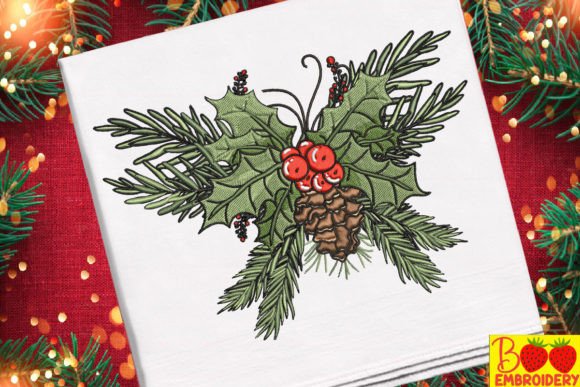
Christmas Pine Branch: A Thoughtful Embroidery Design for Meaningful Gifts
As an embroidery designer who’s developed over 200 seasonal patterns for small shops, Etsy sellers, and boutique gift brands, I test every new machine embroidery design through the lens of real-world use—not just stitch count or hoop compatibility, but how it lands emotionally on a finished product. When I opened Christmas Pine Branch, my first thought wasn’t “Will it stitch?”—it was “Who will hold this in their hands, and what will it make them feel?”
A First Impression That Feels Like Home
Christmas Pine Branch delivers quiet elegance—not flashy, not fussy, but deeply intentional. It reads as both timeless and tender: slender pine needles taper naturally, subtle berry clusters nestle between stems, and the overall silhouette flows with organic rhythm. There’s no cartoonish exaggeration or rigid symmetry—just gentle asymmetry that whispers “hand-drawn,” even though it’s a digital embroidery file. It feels seasonal without being cliché, elegant without being cold, and festive without shouting. For customers seeking warmth over whimsy—think baby embroidery for a newborn’s heirloom blanket or a wedding gift stitched onto linen napkins—it hits the right emotional note.
Where Christmas Pine Branch Shines (and Why Customers Choose It)
This design isn’t just versatile—it’s purpose-built for personalization. Here’s where it consistently elevates a small shop product:
- Baby embroidery: Stitched on a soft cotton muslin blanket or knit onesie (with proper stabilizer), Christmas Pine Branch reads as a gentle, nature-inspired welcome—not a loud holiday motif. Parents love its subtlety for nursery decor and keepsakes.
- Wedding gifts: On ivory linen pillow covers or monogrammed tea towels, it adds seasonal charm without competing with the couple’s names or date. Paired with a simple script font, it becomes a quiet heirloom.
- Embroidered towel & kitchen textiles: Its moderate size and open stitch layout prevent stiffness on terry cloth. Unlike dense floral motifs, it breathes—and stays plush after washing.
- Pillow covers & tote bags: The branch’s natural curve adapts beautifully to rounded corners and side seams. It avoids awkward truncation, making mockups look polished before stitching.
- Etsy listings & craft fair displays: Because it photographs so well—even on neutral backgrounds—it boosts buyer engagement. Customers linger longer when they can imagine it on their favorite item.
Where to Use Christmas Pine Branch With Intention
Not every surface is equal—and Christmas Pine Branch, like all thoughtful embroidery files, asks for mindful placement. Here’s where extra care pays off:
- Stretchy baby clothes: Avoid tight-knit fabrics unless you’ve tested with cutaway stabilizer and reduced stitch density. Pine needles can distort if the fabric gives too much.
- Thick or textured fabric: On heavy waffle-weave towels or bouclé pillow covers, confirm your hoop size accommodates the full design—and that your machine handles layered stabilizer without skipping.
- Dark fabric: Light thread colors (ivory, sage, pale gold) pop beautifully—but always run a printable mockup first. What looks delicate on screen may vanish on charcoal linen without contrast testing.
- Curved surfaces (mugs, ornaments, curved aprons): This design works best on flat or gently contoured areas. Avoid wrapping it tightly around seams or edges where distortion is likely.
- Frequent-wash items: For embroidered towels or baby blankets, verify thread colorfastness and reinforce backstitching at key junctions—especially where berries meet stems.
How Christmas Pine Branch Builds Trust—and Sales
In handmade markets, perceived value isn’t just about materials—it’s about intentionality. When customers see Christmas Pine Branch on a custom tote bag or pillow cover, they sense craftsmanship: the spacing between needles, the weight of each berry, the absence of overcrowded fill stitches. That translates directly to trust. They believe you chose this design because it matters—not because it’s trending.
It also strengthens emotional connection. A grandmother ordering a baby blanket with Christmas Pine Branch isn’t buying decoration—she’s investing in continuity, calm, and quiet celebration. That feeling shows up in reviews (“so peaceful,” “felt like a family heirloom”), which then boost visibility for Etsy sellers and small shop owners alike.
And let’s talk photography: because the design has clear negative space and balanced proportions, it lights evenly. No harsh shadows hiding detail. No need for heavy editing. That means faster product shoots—and more authentic, scroll-stopping images.
Practical Notes Before You Stitch
Before adding Christmas Pine Branch to your next batch of personalized gifts, take these five practical steps:
- Test on scrap fabric that matches your final product—same fiber content, same weight, same finish.
- Check thread color contrast across light and dark bases. Ivory thread on cream linen? Gorgeous. On navy denim? May need a deeper sage or charcoal.
- Confirm hoop size and stitch density—especially if layering with monograms or names. Overly dense fills can overwhelm the delicate branch structure.
- Use appropriate stabilizer: tear-away for stable wovens, cutaway for knits, and fusible + tear-away for terrycloth. Skipping this step risks puckering that breaks the design’s serene flow.
- Verify commercial licensing before selling finished products. Since Christmas Pine Branch is marketed for clothes, home decor, and Christmas gifts, double-check whether your intended use falls within permitted terms—especially for digital embroidery file resale or subscription bundles.
Remember: the most beautiful machine embroidery design is the one that serves both the maker and the receiver. Christmas Pine Branch does that quietly, reliably, and with grace. It doesn’t demand attention—it invites it. And in a crowded market of personalized gifts, that kind of thoughtful presence is exactly what builds loyalty, repeat orders, and word-of-mouth warmth.