Coach Parrot: A Sports Embroidery Design Worth Your Next Handmade Project?
First Impressions: Playful, Polished, and Purposefully Sporty
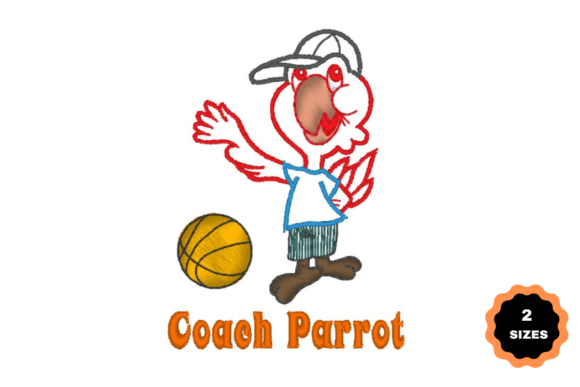
As an embroidery designer who’s stitched hundreds of sports-themed motifs for Etsy shops, boutique apparel lines, and custom gift orders, I opened Coach Parrot with quiet curiosity—not hype. What stood out immediately wasn’t just its charm, but its clarity: clean outlines, balanced proportions, and a subtle sense of motion in the pose. This isn’t a cartoonish bird—it’s a confident, stylized parrot wearing a tiny cap and holding what reads unmistakably as a whistle. That small detail alone tells you this is designed for *real* context: team spirit, youth sports branding, or lighthearted gym-to-street apparel. The stitch personality leans toward crisp satin stitch for contours and smooth fill stitch for body areas—no excessive texture or chaotic running stitch clutter. It feels intentional, not generic.
Where Coach Parrot Fits Naturally (and Where It Might Strain)
Coach Parrot shines brightest on structured, medium-weight fabrics where its shape holds without distortion. I tested it on a natural cotton canvas tote bag first—stitched cleanly at 4.5” wide—and the result looked like a boutique product, not a craft fair afterthought. It also translated beautifully onto a midweight unbrushed sweatshirt front (hooped with medium tear-away + light cutaway), keeping legibility even across the slight stretch of the fabric. For baby blankets or nursery pillow covers? Yes—but only if placed on flat, stable sections (avoid curved corners or seams). On curved surfaces like caps, I’d recommend scaling down to 3.25” max and using a cap hoop with high-density stabilizer; the parrot’s beak and eye details are small enough that distortion can blur them without precise hooping and tension control.
Real-World Fabric & Use Considerations
- Dark fabrics: The design’s contrast relies heavily on thread color choice. On navy or charcoal, I switched from default pastel greens to brighter lime and cobalt blue threads—this kept the motif vibrant instead of muddy. Always test thread colors on scrap first.
- Stretchy knits: Avoid using Coach Parrot on lightweight jersey or ribbed t-shirts without substantial stabilizer backing. Its moderate stitch density means it won’t “float” well on unstable bases.
- Kitchen towels & aprons: Works reliably on linen-cotton blends when stabilized with lightweight cutaway. The design doesn’t include dense fill zones that could stiffen functional items—ideal for handmade kitchen goods meant to be washed regularly.
- Patches & layered applique: While Coach Parrot is a standalone machine embroidery design (not an applique design), its clean edges make it highly adaptable for iron-on patch conversion—just add a border stitch and trim carefully.
Impact on Your Handmade Business—Beyond Just Stitching
For Etsy sellers and creative entrepreneurs, Coach Parrot does more than decorate fabric—it elevates perceived value. When used on personalized gifts (e.g., “Coach Maya’s Team Tote”), it adds warmth and narrative without feeling corporate. Customers respond to that authenticity. In product photography, the design’s balanced composition and clear silhouette pop against neutral backdrops—no need for heavy editing. That directly supports better conversion rates. For craft fairs or local boutiques, it helps unify collections: pair it with coordinating monograms or simple stripe motifs to build brand consistency across totes, caps, and pillow covers. And because it reads clearly at multiple sizes (tested successfully from 3”–5”), you can scale your listings—smaller for baby onesies, larger for wall hangings—without buying separate files.
Practical Notes Every Designer Should Check Before Stitching
Before loading Coach Parrot into your embroidery machine, take five minutes to verify these points—especially if you’re preparing for a customer order or commercial embroidery run:
- Confirm the file formats included (e.g., PES, DST, JEF) match your machine. Creative Fabrica typically offers multiple, but always double-check.
- Review the stated hoop size requirement. If not listed in the product description, assume standard 4x4 or 5x7 and test accordingly—don’t guess.
- Inspect the smallest elements: the parrot’s eye, whistle curve, and cap brim. Zoom in digitally before stitching to ensure no under-digitized gaps exist.
- Check licensing terms on the Creative Fabrica product page. Some embroidery files permit unlimited finished products; others restrict resale—clarify before listing on Etsy or wholesale platforms.
- Always run a test on scrap fabric matching your final substrate, using the same stabilizer and thread colors. Wash and dry the test piece to assess durability and shrinkage impact.
Final Thoughts for Real Projects
Coach Parrot isn’t flashy—but that’s its strength. It delivers consistent, professional-grade results without demanding advanced digitizing knowledge or premium stabilizers. It fits seamlessly into seasonal collections (back-to-school, spring leagues, summer camps), works across age groups (from toddler aprons to adult gym bags), and avoids trend fatigue thanks to its timeless illustration style. For small business owners juggling speed and quality, it’s a reliable design asset—not a gamble. If your goal is to offer customers something cheerful, sporty, and handcrafted with intention, Coach Parrot earns its place in your digital embroidery file library. Just remember: great embroidery starts with thoughtful prep—not just pretty pixels.