Cherry Christmas Cute Cherries Xmas
A Designer’s First Look: Sweet, Simple, and Seasonally Sincere
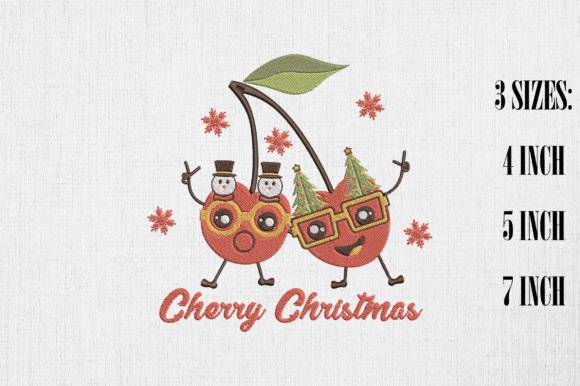
When Cherry Christmas Cute Cherries Xmas popped up in my inbox—clean preview, no flashy animation, just a crisp outline against white—I paused. Not because it’s complex, but because its charm is so quietly intentional. It’s not overloaded with snowflakes or glittery script; it’s two plump, glossy cherries with green stems and tiny white highlights, nestled beside a modest “Xmas” in rounded, friendly lettering. The mood? Warm, nostalgic, gently playful—not kitschy, not corporate, not overly cutesy. It feels like the kind of embroidery design you’d stitch onto a linen tea towel for your sister’s holiday brunch, or onto a baby onesie for a December birthday. It doesn’t shout “Christmas!”—it whispers it, with cherry-stem elegance.
How It Lives in Real Projects (Not Just Mockups)
Last week, I used Cherry Christmas Cute Cherries Xmas to embroider a set of organic cotton tote bags for a local boutique’s holiday pop-up. We chose soft charcoal fabric, medium-weight twill, and a 4×4 hoop. The result? Clean, legible, and surprisingly versatile. Customers gravitated to it—not as “just another holiday design,” but as something that felt handmade *and* intentional. One woman bought three: one for her niece’s teacher, one for her own kitchen, and one framed as nursery decor. That tells me something important: this machine embroidery design bridges personal gifting and small-batch retail without straining either.
It also worked beautifully on a lightweight cotton apron—no puckering, no thread breakage—even though the satin stitch on the cherry highlights required careful tension adjustment. On a fleece-lined sweatshirt? Slightly less crisp in the stems, but still charming when paired with light stabilizer and reduced density. Where it truly shines is on stable, midweight fabrics: tea towels, pillow covers, structured scarves, and baby blankets. It’s not built for high-detail realism, and that’s its strength—it’s confident in its simplicity.
Where to Use It Thoughtfully (Not Everywhere)
Cherry Christmas Cute Cherries Xmas isn’t a one-size-fits-all embroidery file. It’s best avoided on highly textured fabrics like bouclé or thick terry cloth—the delicate stem curves and small lettering can blur. On stretchy knits (think baby bodysuits or ribbed cuffs), it needs extra stabilization and possibly a slight digitized reduction in width to prevent distortion. Dark fabrics demand attention to thread color contrast: white or pale pink thread on navy reads sweetly, but beige on black disappears. And while it fits neatly in a 4×4 hoop, pushing it into a 3×3 requires checking whether the “Xmas” lettering stays legible—small caps can lose clarity fast.
I wouldn’t recommend it for curved surfaces like baseball caps unless you’re using a cap frame and have tested the stitch path across the crown seam. Also, avoid layering it over seams or zippers—those tiny running stitch accents around the cherries won’t hold up if stitched over uneven terrain. As an applique design? Not ideal—it’s digitized as a full-coverage embroidery project, not a layered cut-and-sew motif.
What It Adds to Your Finished Product (Beyond Just Looks)
This design quietly elevates perceived value. Because it’s balanced—not too busy, not too sparse—it makes even simple items feel considered. A plain cream sweater with Cherry Christmas Cute Cherries Xmas on the chest reads boutique-worthy, not craft-fair-basic. For Etsy sellers, it performs well in printable mockups: the clean lines scale nicely from thumbnail to full-size listing image, and the cherry motif reads instantly at small sizes. It also supports brand consistency—if your shop leans into gentle, nature-adjacent holiday themes (think dried citrus, wool felt, linen), this fits right in.
Customers notice the care in the details: the subtle satin stitch sheen on the cherries, the even fill stitch in the letters, the intentional spacing between fruit and text. That builds trust. When someone sees that level of refinement in a handmade product, they assume more thought went into the whole process—fabric choice, finishing, packaging. It’s not just embroidery; it’s storytelling with thread.
Practical Notes Every Designer Should Run Through
- Test first—always—on scrap fabric matching your final project’s weight and weave.
- Check stitch density: dense areas (like the cherry highlights) may need lighter top tension or slower speed on older machines.
- Confirm hoop size before digitizing adjustments—don’t assume it fits your standard setup.
- Inspect small details under magnification: are the stem tips sharp? Does “Xmas” kern evenly?
- Try black-and-white mockups: if it reads clearly in grayscale, it’ll translate well across fabric colors.
- Use appropriate stabilizer: tear-away for stable wovens, cut-away for knits, and light fusible for delicate linens.
- Verify licensing before selling finished items or bundling the digital embroidery file—this affects Etsy sellers and craft business owners directly.
- Compare light/dark backgrounds in your design software—not just on screen, but with actual thread swatches.
Final Thought: A Design That Works Quietly, But Consistently
Cherry Christmas Cute Cherries Xmas won’t win awards for technical complexity—but it’s the kind of embroidery design that earns repeat orders, heartfelt thank-you notes, and quiet confidence from designers who know that great holiday embroidery isn’t about volume, it’s about resonance. It fits naturally into custom apparel, personalized gifts, and small shop merchandise without demanding special treatment or apologies. If your goal is joyful, wearable, commercially sound holiday embroidery—without the stress of over-engineered motifs—this one earns its place in your design assets. Just remember: test, stabilize, and trust the simplicity.